
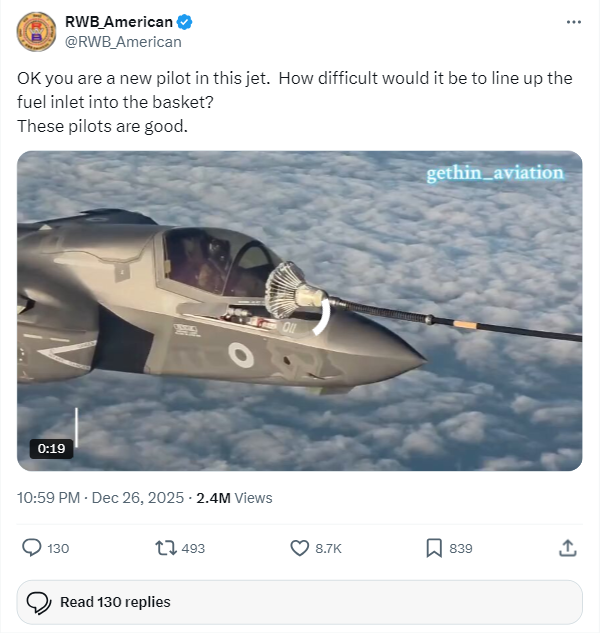
OK you are a new pilot in this jet. How difficult would it be to line up the fuel inlet into the basket?
These pilots are good. pic.twitter.com/IbCHq7qe5G— RWB_American (@RWB_American) December 26, 2025
The tweet from RWB_American, dated December 26, 2025, perfectly encapsulates the sheer awe and profound respect commanded by military aviators performing one of the most intricate and dangerous maneuvers in modern flight: aerial refueling. Posing a rhetorical question to a hypothetical ‘new pilot,’ the author immediately brings into focus the immense skill required to dock a high-speed jet with a delicate, yet crucial, ‘basket’ trailing from a tanker aircraft.
Aerial refueling, often referred to as ‘air-to-air refueling’ (AAR), is a critical capability that transforms the operational range and endurance of military aircraft. Without it, fighter jets, bombers, and reconnaissance planes would be severely limited by their internal fuel capacity, necessitating frequent returns to base. This mid-air ballet allows missions to be extended for hours, sometimes even days, enabling global reach and sustained combat operations far from land bases.
The specific method highlighted by the tweet, involving a ‘fuel inlet into the basket,’ refers to the probe-and-drogue system. In this setup, the tanker aircraft trails a flexible hose with a parachute-like cone, or drogue, at its end. The receiving aircraft, equipped with a rigid probe, must then precisely maneuver itself to insert its probe into this small, constantly moving basket. Imagine threading a needle while both the needle and your hand are travelling at hundreds of miles per hour, often in turbulent air, hundreds or thousands of feet above the ground. The margins for error are razor-thin.
The challenges are multifaceted. Pilots must maintain incredibly precise formation flying, accounting for wake turbulence generated by the tanker, potential crosswinds, and the dynamic movement of the drogue. Visual cues can be deceptive, especially at night or in adverse weather conditions. The pilot’s hands must execute minute, almost imperceptible corrections to keep the powerful jet steady and guide the probe home. This isn’t just about raw power; it’s about exquisite finesse, spatial awareness, and an almost intuitive understanding of aerodynamics and fluid dynamics.
Training for aerial refueling is rigorous and extensive, demanding hundreds of hours in simulators and real-world flights. Pilots must develop an acute sense of depth perception, reaction time, and the mental fortitude to remain calm under intense pressure. A botched attempt can lead to damage to both aircraft, a dangerous fuel spill, or, in the worst case, a complete failure to refuel, potentially leaving the receiving aircraft critically low on fuel far from safety.
The tweet’s simple closing statement – ‘These pilots are good’ – is an understated tribute to an extraordinary group of professionals. It underscores the quiet mastery and unwavering dedication of aviators who routinely perform feats that would leave most civilians speechless. Their proficiency in aerial refueling is not merely a technical skill; it’s a testament to the pinnacle of human-machine interaction, enabling modern air power to project its influence across continents and oceans. It is, quite simply, one of aviation’s most demanding and vital achievements.
About the Author

