
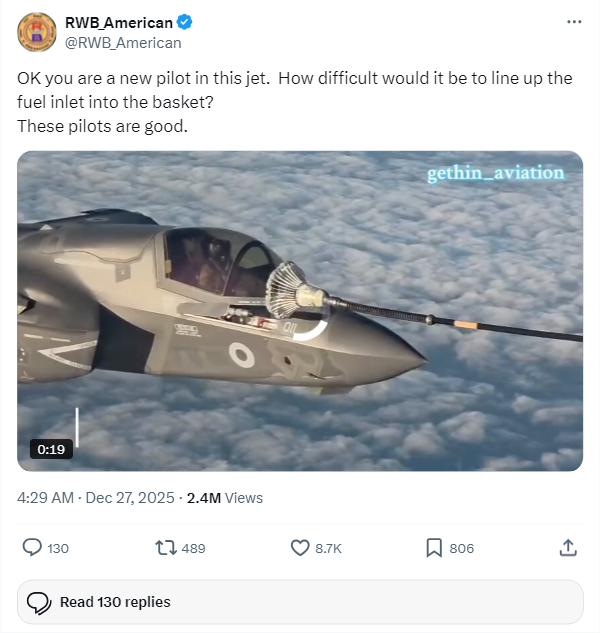
OK you are a new pilot in this jet. How difficult would it be to line up the fuel inlet into the basket?
These pilots are good. pic.twitter.com/IbCHq7qe5G— RWB_American (@RWB_American) December 26, 2025
A recent tweet from RWB_American, posted on December 26, 2025, sparked a compelling question that resonates with anyone who has ever marvelled at the intricacies of aviation: “OK you are a new pilot in this jet. How difficult would it be to line up the fuel inlet into the basket? These pilots are good.” The accompanying image, while not directly visible, undoubtedly depicted the breathtaking act of aerial refueling, a ballet of precision and skill performed thousands of feet above the Earth.
The scene described is one of the most challenging and critical maneuvers in military aviation. Aerial refueling, or “tanking,” allows aircraft to extend their range and endurance without needing to land, thereby significantly enhancing their operational capabilities. For a fighter jet pilot, or indeed any pilot involved in such an operation, lining up a small fuel probe with an even smaller drogue (often referred to as a “basket”) trailing from a tanker aircraft is a task that demands absolute mastery of their machine and an unwavering focus.
Imagine flying a multi-million-dollar aircraft, weighing tens of thousands of pounds, at speeds exceeding 250 knots (around 287 mph). Now, add another colossal aircraft flying just tens of feet ahead, creating its own wake turbulence. The pilot must precisely maintain position relative to the tanker, adjust for minute changes in speed and altitude, and then, with surgical precision, guide the aircraft’s fuel probe into the basket, which is essentially a funnel-shaped receptacle at the end of a flexible hose. This isn’t a static target; it’s constantly swaying and moving with the air currents and the tanker’s own subtle movements.
The difficulty is compounded by numerous factors. The pilot’s field of vision is restricted, they are contending with G-forces, constant communication with the tanker crew, and the inherent stress of operating a complex machine in close proximity to another. It requires exceptional hand-eye coordination, depth perception, and an intuitive understanding of aerodynamics and aircraft control. Years of intensive training, thousands of flight hours, and a deep understanding of their aircraft’s performance characteristics are prerequisites for any pilot attempting this feat.
This maneuver is not just about topping off a fuel tank; it’s about strategic advantage. It allows bomber aircraft to reach distant targets, fighter jets to maintain combat air patrols for longer durations, and transport aircraft to deliver critical supplies across continents without intermediate stops. Without aerial refueling, many modern air operations would be severely limited in scope and effectiveness.
The tweet’s statement, “These pilots are good,” is an understatement of epic proportions. It underscores the immense respect and admiration for the men and women who perform these daily acts of aerial artistry. For a “new pilot,” as the tweet posits, the task would be daunting, if not impossible, without extensive specialized training. It’s a testament to the dedication, skill, and rigorous standards of military aviation that such complex and dangerous operations are performed routinely and safely. The next time you see footage of a jet being refueled mid-air, remember the incredible skill and precision involved in what appears, to the uninitiated, to be just another flight.
About the Author

