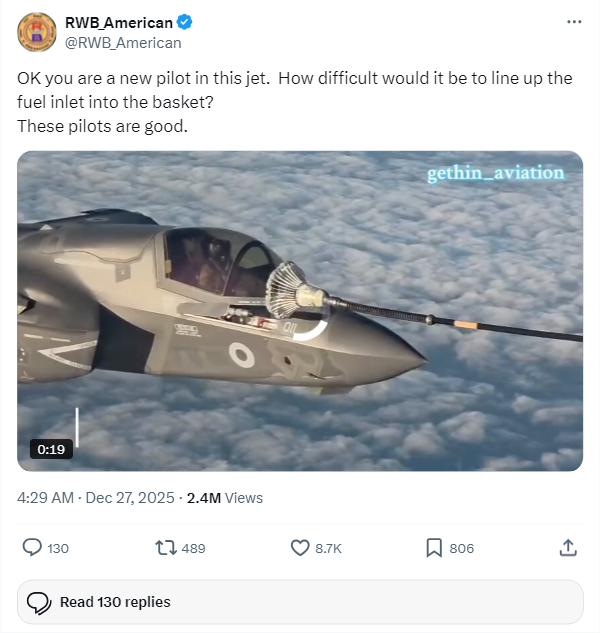
OK you are a new pilot in this jet. How difficult would it be to line up the fuel inlet into the basket?
These pilots are good. pic.twitter.com/IbCHq7qe5G— RWB_American (@RWB_American) December 26, 2025
The simple question posed by a recent tweet from RWB_American on December 26, 2025, resonated widely: “OK you are a new pilot in this jet. How difficult would it be to line up the fuel inlet into the basket? These pilots are good.” Accompanied by an image (or the implied visual) of an aerial refueling operation, the tweet perfectly encapsulates the awe and respect due to the incredibly skilled individuals who execute one of aviation’s most challenging and critical maneuvers.
Imagine yourself in the cockpit of a high-performance military jet, soaring thousands of feet above the earth at speeds exceeding 200 miles per hour. Ahead, another aircraft, a tanker, trails a flexible hose with a cone-shaped “basket” or drogue. Your mission: insert a probe from your aircraft into that basket to receive vital fuel, extending your range and mission endurance. This isn’t a task for the faint of heart or the marginally competent; it’s a ballet of precision, nerve, and unparalleled aeronautical skill.
Aerial refueling, often referred to as “tanking,” is a cornerstone of modern air power, enabling military aircraft to stay airborne for extended periods, traverse vast distances, and remain on station longer for reconnaissance, combat, or transport missions. Without it, global projection of air power would be severely limited, and many long-range operations would be impossible.
The difficulty lies in several factors. Both aircraft are in constant motion, subject to air currents, turbulence, and the subtle movements of the pilots. The receiving pilot must precisely match the tanker’s speed and altitude, maintaining station often just tens of feet behind a much larger aircraft. Then comes the delicate act of guiding the refueling probe, a relatively small appendage, into the moving, swinging drogue. It’s akin to threading a needle while both the needle and the thread are hurtling through the air in a hurricane – except the consequences of failure can be catastrophic, involving mid-air collisions, fuel spills, or even explosions.
Pilots undergo rigorous training for years before they are certified for aerial refueling. This includes extensive simulator work, where every conceivable scenario, from calm skies to severe turbulence, is practiced. Followed by supervised flights under the watchful eyes of experienced instructors, these pilots hone their hand-eye coordination, depth perception, and spatial awareness to an extraordinary degree. They learn to anticipate the subtle movements of the tanker, understand the dynamics of the drogue, and react instinctively to maintain a steady connection.
The mental fortitude required is immense. It demands intense concentration, unwavering focus, and the ability to remain calm under extreme pressure. Every pilot performing this feat is a testament to human capability and the pinnacle of professional aviation training. The process isn’t just about lining up a hose; it’s about managing fuel flow, monitoring systems, communicating with the tanker crew, and always being prepared for contingencies.
So, when RWB_American asks how difficult it would be, the answer is unequivocally: extremely difficult. It’s a maneuver that separates the truly exceptional pilots from the merely proficient. It’s a silent, often unseen, but absolutely essential operation that allows air forces worldwide to maintain their reach and effectiveness. The next time you see footage or an image of aerial refueling, remember the incredible skill, the unwavering focus, and the countless hours of training that go into making such a seemingly impossible task a routine reality for these “good pilots.” They truly are masters of the sky.
About the Author